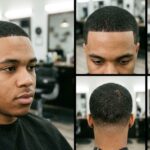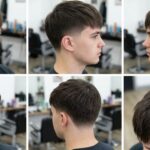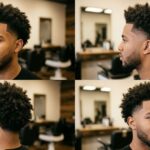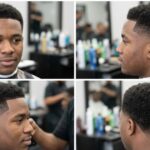
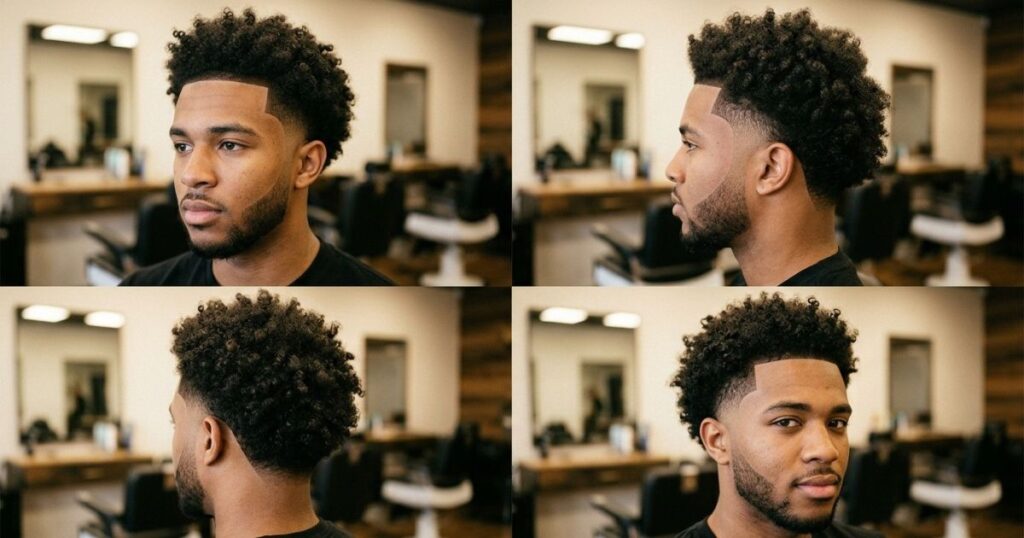
Burst Fade for Curly Hair curves in a rounded arc around the ear, then fades toward the nape. Your curls keep their length on top. The cut removes side bulk without flattening your texture, which is why curly-haired clients and barbers both keep choosing it.
This guide covers fit, low, mid and high heights, ready-to-show styles, a barber script, daily styling, wash-day care, touch-up timing, grow-out and fixes. Use it to walk into the chair knowing what you want, instead of hoping your barber guesses right.
What is a burst fade on curly hair?
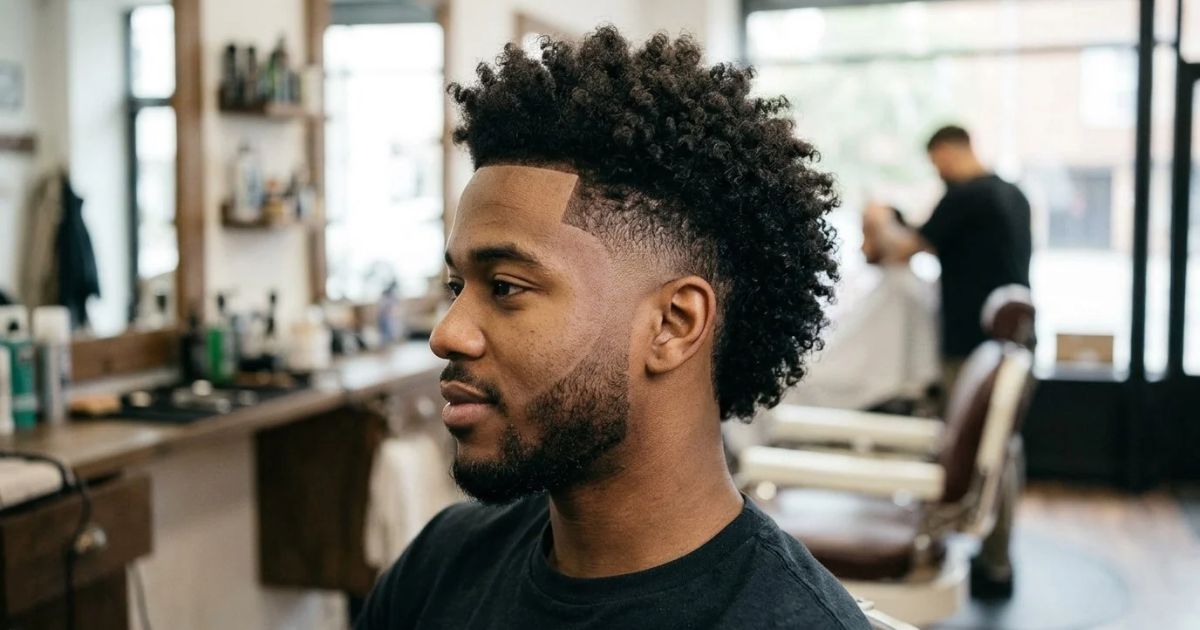
A burst fade is a haircut where the fade follows a curved path around and behind the ear instead of running in a straight line down the side. On curly hair, that curve blends into your natural texture above it. The shape describes the fade’s path, not how short it finishes.
That difference matters. Two people can both say “burst fade” and leave with very different cuts. One may have bare skin at the ear and a long mullet back. The other may have a soft shadow and a compact curly crop.
Which parts of the haircut can be customized?
Six choices change how a burst fade looks. Name each one to your barber instead of relying on a single photo.
| Variable | What you are deciding |
| Fade height | Where the arc starts: low, mid or high |
| Finish | Bare skin, zero guard, shadow or a longer guard |
| Arc width | A tight curve or a wide, gradual sweep |
| Side weight | How much hair stays directly above the fade |
| Top shape and length | Cropped curls, a fringe, a rounded top or extra height |
| Back and neckline | Natural, tapered, blocked or longer for a mullet |
Why does the burst shape work with curls?
Curly and coily hair builds bulk around the ears, and that bulk can make the head look wider than it is. The burst arc clears that area and leaves the top free to hold its shape.
It also gives you control over contrast. A low shadow burst looks quiet. A high skin burst looks sharp and graphic. The haircut is flexible, but it is not automatically low maintenance, because a crisp arc shows regrowth fast.
Will a burst fade suit your curls?
For most people, yes. The cut adapts to loose waves, defined curls and tight coils by changing the arc height, the side weight and the finish. Your hair’s behavior matters more than a curl-type label like 3A or 4C, so think of this as a set of choices, not a yes-or-no test.
What hair factors matter most?
Density, shrinkage and growth direction shape the result more than curl pattern alone.
| Hair factor | How it affects the burst fade |
| Density | Thick hair carries a higher or wider arc. Thin hair needs more weight kept above the fade. |
| Strand thickness | Fine strands show the scalp sooner at the same guard length. |
| Shrinkage | Curls can dry much shorter than they look stretched or wet, so the top is usually left longer. |
| Crown and cowlick direction | Decides where the arc can blend cleanly into the top. |
| Chemical or heat history | Relaxed, permed or heat-trained hair behaves differently and needs its own plan. |
Ask your barber to look at your hair dry and in its natural state. A cut planned on stretched hair can look shorter than expected once it springs back.
What face, head-shape, and lifestyle factors matter?
Head shape and upkeep matter more than strict face-shape rules. A higher, wider arc adds contrast and visual height. A lower, softer arc is easier to wear between appointments.
Weigh these before you book:
- Head and crown shape: flat spots or a prominent crown change how the arc sits.
- Face shape: round faces often suit extra height on top, while square faces often suit a mid fade with softer curls.
- Work or school rules: a shadow finish is usually easier to defend than bare skin.
- Barber schedule: if you can only visit every six weeks, choose a lower, softer finish.
- Scalp sensitivity: close cutting around the ear and nape can irritate some skin.
Read More:High Taper Fade Haircut: What It Is, Who It Suits, and What to Ask For
Should you choose a low, mid, or high burst fade?
Low, mid and high describe where the fade starts on the side of your head. They do not describe how short it finishes. Mid is the safest default if you are unsure.
| Feature | Low burst fade | Mid burst fade | High burst fade |
| Starts | Just above the ear | Between the ear and temple | Near the temple or higher |
| Contrast | Subtle | Balanced | Strong |
| Side weight kept | Most | Moderate | Least |
| Grow-out | Softest | Moderate | Shows soonest |
| Best for | Office settings, first-timers | Everyday wear | Thick curls, bold looks |
Tighter curl patterns can look patchy with a very high fade unless the barber blends slowly. If your coils are dense, ask for a gradual blend zone.
Which curly burst fade style should you show your barber?
Pick by silhouette, back length and finish, not by name. Bring one side photo and one rear photo, because the back view often decides the final look.
Which options look subtle and grow out softly?
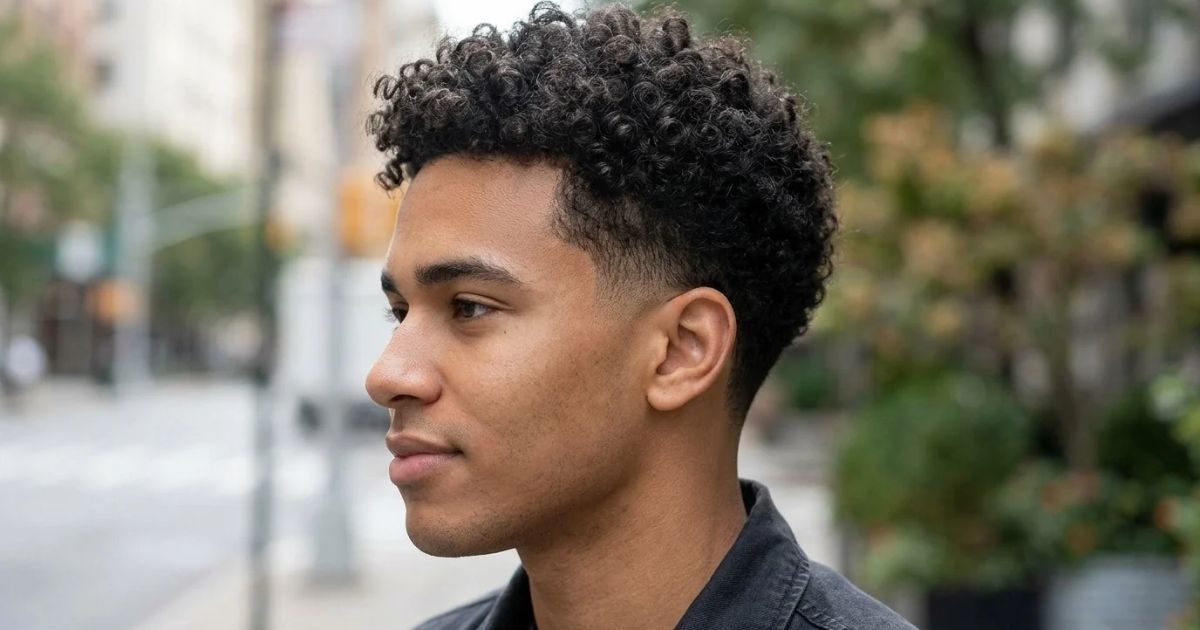
These keep the arc low or stop short of bare skin. The transition looks gradual, so the cut stays presentable longer.
Low shadow burst fade
The arc sits close to the ear and ends in a shadow instead of skin. It is the easiest burst fade to wear to work or school and the most forgiving as it grows.
Low burst fade with short curls or cropped coils
Short curls on top keep the shape compact. Upkeep focuses on the top shape instead of chasing a sharp fade line.
Low burst fade with a natural or tapered neckline
The back is left natural or lightly tapered, not squared off. With no hard edge to maintain, the outline grows out cleanly.
Which options balance contrast and everyday versatility?

Mid placement gives you a clear haircut without the upkeep of a high fade. It works for most curl densities.
Mid burst fade with defined curls or coils
Contrast comes from texture as well as length. Defined curls stand out against the faded sides, so you need very little styling effort.
Burst fade with curly fringe
The fringe is left long enough to fall forward and frame the face. The fade keeps the sides tidy so the fringe does not look heavy.
Mid burst fade with a rounded curly top
The top is shaped into an even dome. This works well on mixed textures and is easy to maintain with a quick refresh.
Which options preserve length and make a bolder statement?
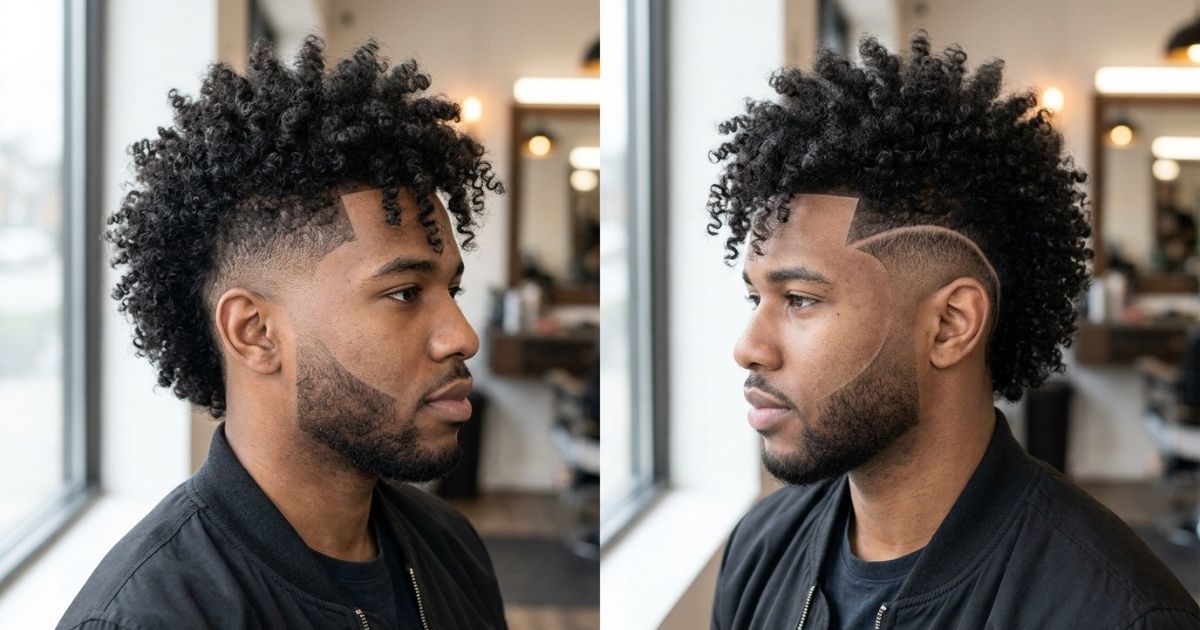
These use a higher arc, more contrast or extra length. Rear-view photos matter most here.
High burst fade with volume
The arc starts higher and removes more side weight, so the top looks bigger. Regrowth shows sooner, so expect shorter gaps between cuts.
Curly burst-fade mullet
The sides are faded short and the back stays noticeably longer. The sharp arc against the longer nape creates the signature contrast.
Curly frohawk or mohawk
The sides are faded close, and a central strip of curls is left tall. It puts all the volume down the middle of the head.
Burst fade vs drop fade vs taper: what is the difference?
A burst fade curves around the ear. A drop fade curves down toward the nape. A taper only shortens the edges. Barbers use these names a little differently, so a reference photo still helps.
| Burst fade | Drop fade | Taper | |
| Fade path | Rounded arc around and behind the ear | Curve that drops toward the nape | Graduation at the edges only |
| Contrast | Sharp but localized | Moderate to high | Soft |
| Back treatment | Blends into a shorter or natural back | Line continues behind the head | Light neckline graduation |
| Grow-out | Arc softens at the edges | Line blurs gradually | Little visible line |
Skin, zero and shadow describe the finish. Any of the three paths can use any finish, so confirm the path and the finish separately.
How do you ask your barber for a curly burst fade?
Give your barber six decisions and two photos. A style name alone leaves too much room for guessing.
Which six decisions should you make first?
- Height: low, mid or high.
- Finish: skin, zero, shadow or a guarded length.
- Arc width: tight and compact, or wide and gradual.
- Side weight: how much hair stays above the fade.
- Top: the dry length and shape you want, not a guard number.
- Back and neckline: natural, tapered or longer.
What should your barber brief and reference photos include?
Show a side photo and a rear photo. Say what to keep as clearly as what to remove, and mention that your hair shrinks as it dries.
Bring this short checklist:
- Preferred height and finish
- How you usually style the top
- Anything in the photo you do not want copied
- Your hair’s growth direction at the crown
Barber script you can adapt:
“I’d like a [low/mid/high] burst fade that curves around my ear, finished at [skin/shadow/zero]. Please leave [amount] of weight above the arc and keep the top close to [length or shape] once it’s dry. Leave the back [natural/tapered/longer]. My curls shrink a lot as they dry, so please cut with that in mind.”
Look for a barber who has experience with textured hair. A good one will ask follow-up questions, which is a green flag.
How should you style a curly burst fade?
Style on damp hair, use less product than you think you need, and handle curls as little as possible. The goal is definition on top without weighing the curls down.
What is the fastest daily styling routine?
- Mist your hair with water until the curls loosen and reform.
- Work a small amount of leave-in or curl cream through the top.
- Scrunch or finger-coil to reform the pattern.
- Place the fringe or top where you want it.
- Air-dry, or diffuse on low heat.
Fine or low-density curls need very little product. Too much will flatten them. For more height than definition, a round brush and a blow dryer on a low setting can lift the top. Keep heat low, because high heat wears down curl pattern over time.
How do you care for curly hair between cuts?
Protect moisture, avoid rough handling and keep your scalp clean. Curly hair usually needs fewer washes than straight hair, but the scalp still needs regular cleansing.
What should wash-day care include?
- Use a sulfate-free or gentle shampoo, and clarify occasionally if you use gels or pomades.
- Condition the full length of your hair, not just the ends.
- Detangle while the hair is wet and coated in conditioner.
- Rinse well so product buildup does not dull your curls.
- Apply a leave-in or light oil to help hold moisture.
- Pat dry with a microfiber towel or soft T-shirt instead of rubbing.
How should you protect curls overnight?
Reduce friction while you sleep. A satin or silk pillowcase or bonnet works for most lengths. If your hair is long enough, a loose pineapple ponytail on top of your head keeps the pattern from crushing. Very short curls just need a light mist of water in the morning.
How often should you refresh a curly burst fade?
Most people refresh a burst fade every two to six weeks, depending on finish and growth speed. Skin finishes need attention sooner because regrowth shows first.
| Finish | Typical refresh window |
| Skin or zero burst | Every 2–3 weeks |
| Shadow burst | Every 3–4 weeks |
| Low burst with natural neckline | Every 4–6 weeks |
These are rough ranges. Your growth rate and how crisp you like the edges matter more than a fixed schedule.
What signals matter more than a fixed calendar?
Watch for these signs:
- The arc no longer reads as a clean curve.
- The contrast against the top has flattened.
- The neckline has drifted from its shape.
- The top has lost its balance or sits unevenly.
- Styling takes noticeably longer than usual.
Cleaning up the fade is a separate job from reshaping the curly top. You can book a quick fade-only visit between full cuts.
How do you grow out a curly burst fade cleanly?
Reduce contrast in stages so the arc does not grow in unevenly.
- Ask your barber to soften a skin finish to a shadow.
- Bring a high burst down to mid, then low.
- Stop widening the arc so side weight can rebuild.
- Keep the neckline tidy while the sides fill in.
- Move toward a taper, a curly crop, a soft mullet or an all-over scissor shape.
A clean neckline makes the grow-out phase look intentional.
What can go wrong, and how do you fix it?
Most problems come from an arc cut too high, too little side weight, ignored shrinkage or heavy product. Tell your barber the exact symptom, not just “it looks off.”
Which haircut or styling mistakes are most common?
| Problem | Likely cause | Fix |
| Top looks too short | Cut stretched or wet, shrinkage ignored | Let it grow, and next time ask for a dry-hair assessment |
| Arc looks too high or wide | Wrong height or arc width chosen | Ask for a softer blend, then grow it down |
| Curls look flat | Too much product or side weight removed | Use less product and clarify |
| Patchy blend on tight coils | Fade taken too high or blended too fast | Request a slower, more gradual blend |
| Frizz and breakage | Brushing dry curls | Detangle wet with conditioner |
| Fade grows out messy | Skin finish with no maintenance plan | Switch to shadow and book a fade-only touch-up |
When should irritation or bumps change the plan?
Occasional razor bumps usually settle with a gentler technique. Painful, persistent or scarring bumps at the nape are different. They can signal conditions such as acne keloidalis nuchae, where very close cuts and shaving may make things worse. See a dermatologist or doctor instead of just changing barbers, and ask for a longer guard in the meantime.
What are the best alternatives to a curly burst fade?
If a burst fade feels too bold, these options keep your curls and change the sides.
| Alternative | Fade path | Contrast | Best reason to choose it |
| Low taper | Edges near ears and neckline | Low | You want tidy, not designed |
| Drop fade | Curve continuing toward the nape | Moderate to high | You want the curve to wrap around the back |
| Temple fade | Small area at the temples | Lowest | You want to keep almost all side length |
| Scissor taper | Gradual blend by scissors, no clipper line | Low | You want the softest grow-out |
Curly burst fade FAQ’S
Does a burst fade have to go down to skin?
No. Burst describes the curved path, not the finish. You can choose skin, zero, shadow or a longer guard.
How long should curly hair be on top?
Leave enough length, after shrinkage, to form your chosen shape. Ask your barber to judge it on dry hair.
Can a burst fade work on both loose waves and tight coils?
Yes. The barber adjusts the height, side weight and blend speed to fit your texture.
Is a curly burst fade professional enough for work or school?
It can be, especially a low or shadow version with a neat neckline. Check any dress code first.
Can fine or low-density curls wear a burst fade?
Yes, if enough weight stays above the arc. A lower, softer finish usually looks best.
Does a burst fade have to be paired with a mullet?
No. Short curls, fringes, rounded tops and frohawks all work with the same fade.
How much does a burst fade cost?
Prices vary by city and shop. Expect to pay a little more than a basic fade for the detail work.
Can I get a burst fade with a beard?
Yes. Ask your barber to blend the arc into your sideburns and beard so the lines connect smoothly.
Conclusion
A curly burst fade comes down to three choices: fade height, finish and the length you keep on top and at the back. Decide those first, save side and rear photos, and tell your barber how your curls shrink. That one detail prevents most surprises.
Then protect the result at home with gentle washing, moisture, light styling and a simple overnight routine. Refresh the arc when it loses its curve, not just when the calendar says so. Done well, this cut stays sharp while keeping your natural curls front and center.