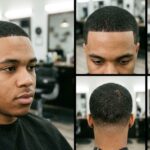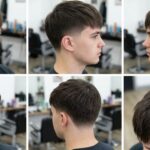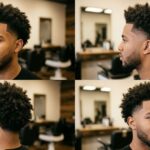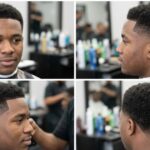
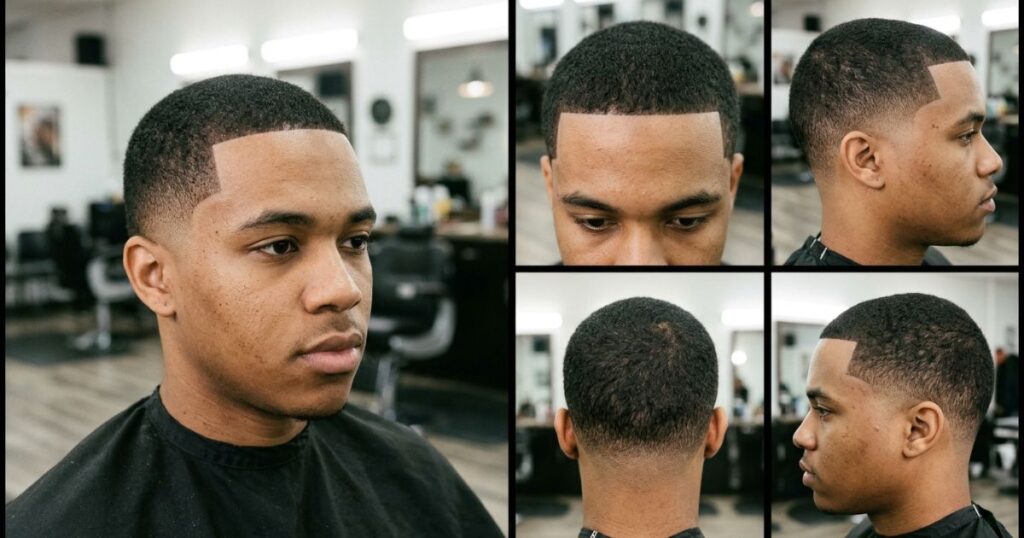
A mid taper fade buzz cut gives you a short, even top and sides that shrink gradually from around the middle of the ear. It looks sharp, needs no styling, and suits most hair types. The catch is that barbers use the word “mid” differently, so the details matter.
This guide explains what the cut is, how it differs from a mid fade or low taper, and which clipper guard to pick. You will also get copy-ready barber scripts, upkeep timelines, skin-care warnings, and smart alternatives, so you can sit in the chair knowing exactly what to ask for.
What is a mid taper fade buzz cut?
A mid taper fade buzz cut is a short, single-length buzzed top paired with sides and a back that get shorter step by step, starting near the middle of the ear. The taper adds shape. The buzz keeps the top simple. Together they look cleaner than a plain all-over buzz.
The name is not standardized. Some barbers use “taper” and “fade” as the same word. Others save “fade” for a blend that reaches bare skin and “taper” for a blend that stops at a light shadow. A photo or a clear description of the finish beats the label every time.
Where does the “mid” taper sit?
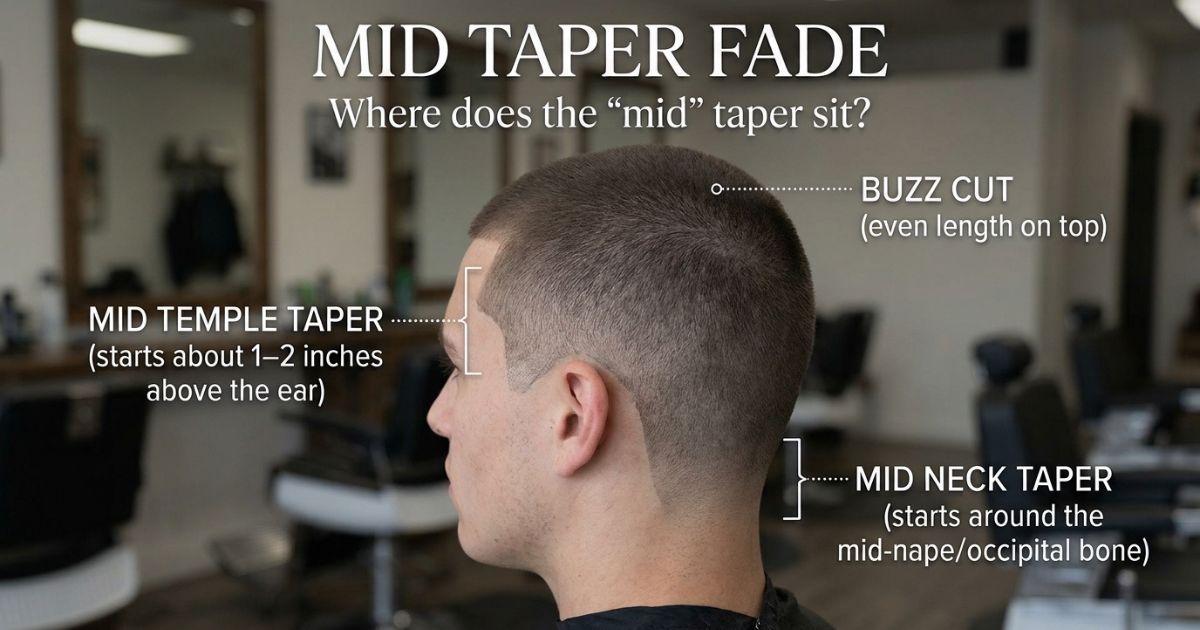
“Mid” describes where the blend begins, not how long your hair is. It starts roughly level with the middle of the ear, which places it between a low taper (near the earlobe and nape) and a high taper (up toward the temple).
Head shapes differ, so a good barber adjusts the starting point to your ear position, hairline, and the contrast you want. Point to the spot on your own head. That is clearer than any measurement.
What makes it a buzz cut?

The top is clipped short with a guard, so it has no real length to comb, part, or style with product. Most clipper brands label guards #1 to #4 for this range. A #1 is about 3mm, a #2 about 6mm, and a #3 about 9.5mm.
Once the top moves past a #4, most people call it a crew cut or brush cut, not a buzz.
Read More:Mid taper fade for straight hair: 8 styles, barber script, and care guide
Mid taper fade buzz cut vs similar cuts: what’s the difference?
The main differences are where the blend starts, how short the sides get, and how much contrast you see against the top. None of these cuts is a strict recipe. They sit on a sliding scale, and barbers place them a little differently.
| Cut | Where the blend starts | Hair left on the sides | Contrast |
| Classic buzz cut | No blend, one length | All even | None |
| Low taper buzz | Near the earlobe and nape | Most | Subtle |
| Mid taper buzz | Level with the middle of the ear | Moderate | Balanced |
| Mid fade buzz | Same height, usually down to skin | Less at the base | Strong at the bottom |
| High taper buzz | Near the temple | Least | Strong overall |
Mid taper vs mid fade
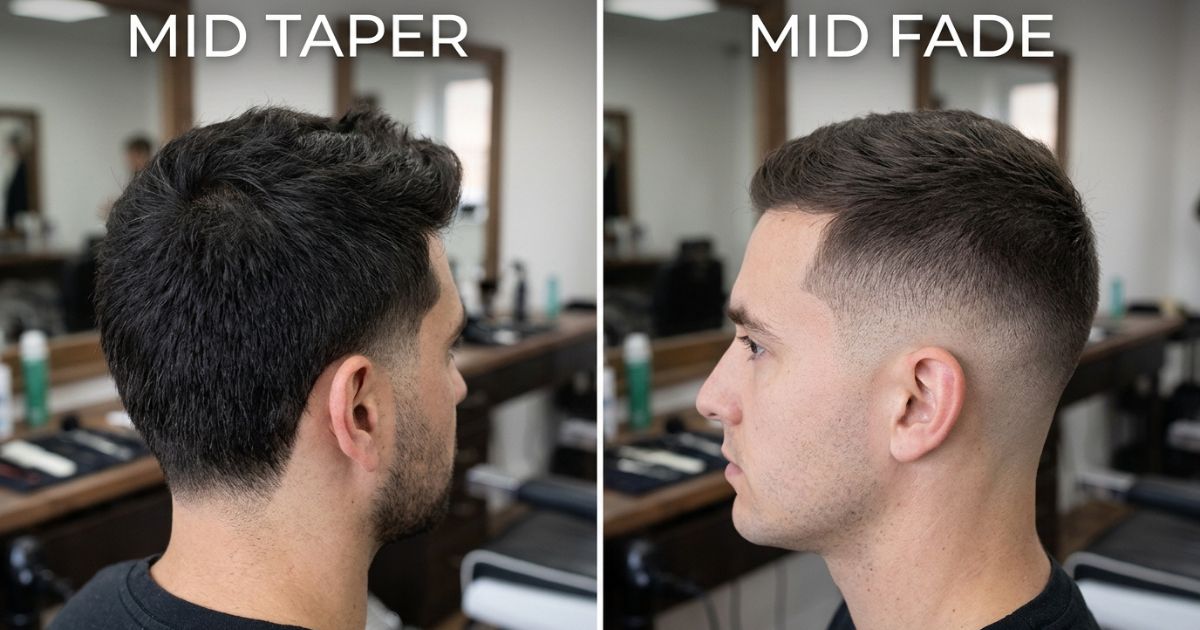
Both start at about the same height. The real difference is the bottom. A mid taper usually leaves a little length or a soft shadow. A mid fade more often drops to bare skin, which looks bolder and shows regrowth sooner.
Because shops use the words loosely, say “to skin” or “leave some length” out loud.
Low vs mid vs high taper buzz cut
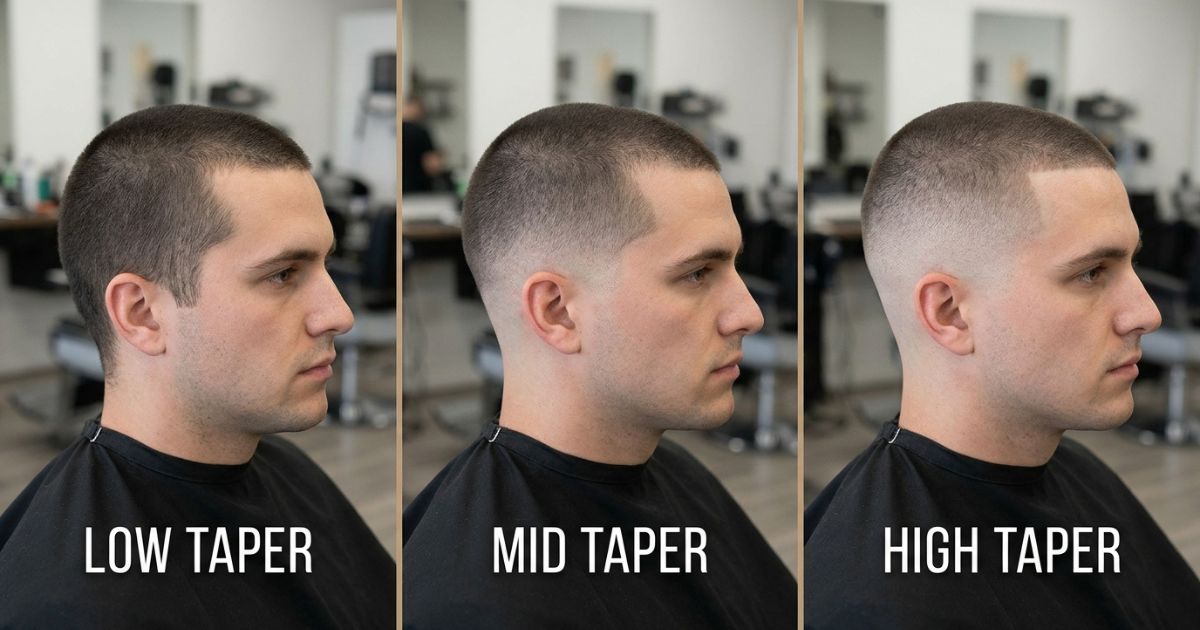
- Low taper: Keeps more bulk on the sides. It looks neat and forgiving, and it grows out slowly.
- Mid taper: Gives clear shape without a harsh step. It is the safe middle choice.
- High taper: Starts near the temple and creates sharper contrast against the buzz. It needs more frequent visits to stay crisp.
Tapered buzz cut vs classic buzz cut or crew cut
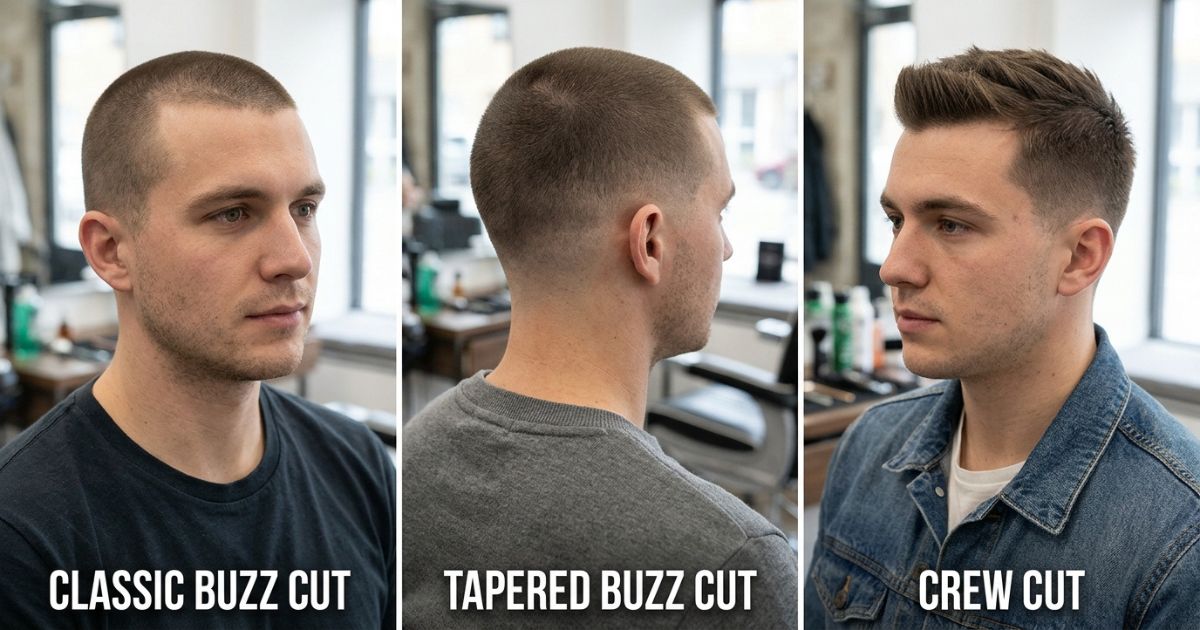
A classic buzz uses one guard everywhere. A tapered buzz keeps the same short top but shapes the temples, ears, and neckline. A crew cut also tapers, yet it leaves enough length on top to comb, so it brings back some daily styling.
| Feature | Classic buzz | Tapered buzz | Crew cut |
| Top length | One short guard | One short guard | Longer, often #4 and up |
| Side shaping | None | Graduated taper | Graduated taper |
| Daily styling | None | None | Light comb or product |
| Barber visits | Easy to DIY | Barber recommended | Barber recommended |
Will a mid taper buzz cut suit you?
Most people can wear it, but the result changes with your hair, your head shape, and your hairline. Think of it as a short list of checks, not a pass or fail test.
How hair texture and density change the look
| Hair type | What to expect | Practical tip |
| Fine, straight | Taper line shows clearly; scalp shows through | Choose a softer blend, or go one guard longer |
| Thick, straight | Holds a solid, even top | A #1 or #2 looks full |
| Wavy | Texture appears at a #3 | Try a #3 if you like movement |
| Curly or coily | Curl shrinkage hides length; the blend looks softer | Ask for the taper to start a touch higher |
| Thinning | More scalp visible at the same guard | Go longer on top to reduce the gap |
How face and head proportions affect the result
Skip the face-shape charts and think in proportions. Starting the taper higher narrows the lower head and jaw area. Starting it lower keeps the sides fuller. If you have a rounder head, a slightly higher start can add definition. If you have a narrow head, a lower start keeps balance.
Barbers also check for bumps, flat spots, and scars, because a buzz shows everything. Ask your barber to point out anything the cut will reveal.
What about a receding hairline, thinning hair, or cowlick?
Very short hair lowers the contrast between thick and thin areas, so many men with thinning crowns like this cut. But short hair also makes the hairline itself easier to see. Treat it as a trade-off, not a fix.
A cowlick usually lies flat at buzz length because there is too little hair for it to stand up. If you have a strong one, a #2 or #3 often behaves better than a very short #1.
What clipper guard should you choose for a mid taper buzz cut?
Most mid taper buzz cuts use a #1, #2, or #3 on top. Guard number only controls the top. It says nothing about the taper, so decide top length and taper placement as two separate choices.
#1 vs #2 vs #3 buzz cut on top
| Guard | Approx. length | Look | Best for |
| #1 | 1/8 in (3 mm) | Very short; scalp clearly visible | Bold, high-contrast look |
| #2 | 1/4 in (6 mm) | Classic buzz; balanced coverage | First-timers and most hair types |
| #3 | 3/8 in (9.5 mm) | Softer; texture shows | Wavy or curly hair, thinner hair |
| #4 | 1/2 in (13 mm) | Crew cut territory | Light styling |
Exact lengths vary slightly between brands, so confirm with your barber if precision matters.
#1 for the sharpest contrast
A #1 shows the most scalp and makes the step into the taper very clear. Choose it if you want a bold look and do not mind more frequent visits. It is less forgiving on uneven head shapes.
#2 for a classic short buzz
A #2 is the easiest starting point. It reads as a haircut, not a shave, and it works on most textures. If you are unsure, start here. You can always go shorter next time.
#3 for a softer, longer buzz
A #3 leaves enough length for waves and curls to show. It also grows out more gently and hides thin spots better than shorter guards.
Longer than a #4: the brush cut crossover
Past a #4, the style behaves like a brush cut or crew cut. It holds shape, can be combed, and often wants a little product. The mid taper still works, but you are now caring for a different haircut.
Should the taper end at skin, zero, or a short shadow?
| Bottom finish | How it looks | Upkeep | Skin note |
| True skin (shaver or razor) | Crisp, high contrast | Highest; shows regrowth in days | Most irritation risk |
| Zero (bare blade) | Very close shadow | High | Can irritate sensitive skin |
| Short shadow (about #1/2 to #1) | Soft, natural blend | Moderate | Gentler on the nape |
| Some length kept | Subtle, forgiving | Lowest | Best for sensitive skin |
The taper never has to reach bare skin. A short shadow gives most of the look with less upkeep and less irritation.
Best mid taper fade buzz cut variations
This cut has fewer real variations than image galleries suggest. Two choices drive almost all of the difference: how long you leave the top, and how you finish the edges.
Choose the variation by top length
- #1 mid taper buzz: The sharpest and most scalp-visible version.
- #2 mid taper buzz: The balanced default that suits most people.
- #3 mid taper buzz: Softer, with room for texture.
- Longer buzz with a mid taper: A #4 or longer on top, which edges into crew cut territory.
Choose the variation by edge finish
- Natural hairline: Left where it grows. Softer and easier to grow out.
- Sharp line-up: Crisp temples and forehead line. Looks best in week one and needs the most touch-ups.
- Skin-close taper: Blend ends at bare skin for maximum contrast.
- Beard blend: The sideburns flow into the beard, so hair and beard read as one shape.
How do you ask your barber for a mid taper fade buzz cut?
Give your barber five details: top guard, taper start, bottom finish, hairline style, and a reference photo. Saying “mid taper buzz” alone leaves too much open to guesswork.
Five things to specify before the clippers start
- Top length: A guard number, or a length in millimeters or inches.
- Taper start: Point to where the blend should begin on the side of your head.
- Bottom finish: Skin, short shadow, or some length left.
- Hairline and neckline: Sharp line-up or natural edge, plus rounded, squared, or tapered neck.
- Reference photo: Show the side and back, not just the front.
Ready-to-use barber scripts
Use these as starting points. Swap in your own numbers.
Balanced #2 version
“Can I get a #2 on top, with the taper starting about halfway up my ear and finishing at a light shadow? Keep the hairline natural, please.”
Softer, non-skin version
“I want a #3 on top and a gentle taper that begins a bit lower, near the bottom of my ear. Please leave a little length at the base instead of going to skin.”
Sharper skin-close version
“A #1 or #2 on top, with a mid taper that goes all the way down to skin. I would like a clean line-up and a tidy neckline.”
Add one more line: “If something else would suit my head better, tell me.” That gives a good barber room to help.
How do you maintain a mid taper fade buzz cut?
Daily care is almost nothing. The challenge is timing. The taper loses its shape faster than the top does, because a few millimeters at the base change the shape far more than the same growth on a #2 top.
How often should you refresh the cut?
Scalp hair grows roughly half an inch a month, which is about 1 to 1.5 mm in a typical week. A skin-close bottom looks soft in a week or two. A softer taper holds longer.
| Finish | Typical refresh window |
| Skin-close taper with sharp line-up | Every 1 to 2 weeks |
| Short shadow taper | Every 2 to 3 weeks |
| Soft taper with length kept | Every 3 to 4 weeks |
Watch the outline, not the calendar. When the line between the top and the taper starts to blur, book the next visit.
What maintenance can you do between barber visits?
- Wash your scalp regularly. Short hair leaves more skin exposed to oil and sweat.
- Moisturize if your scalp feels dry or tight.
- Tidy loose neck hairs with a trimmer, but stay below the line your barber cut.
- Leave the taper itself alone. DIY fixes often push the line higher and make the next cut harder.
What are the risks and limitations of a very short tapered buzz?
Short cuts save styling time, but they expose more skin. Think about neck irritation, sun exposure, and how often you can visit a barber before you commit.
Close shaving, razor bumps, and AKN
Very close haircuts can irritate the back of the neck. The American Academy of Dermatology lists frequent close-shave haircuts as a factor in acne keloidalis nuchae (AKN), a condition that causes bumps and, if untreated, scarring and hair loss at the back of the scalp. It is most common in men of African ancestry, and it also affects Hispanic and Asian men with darker skin and coarse, curly hair.
For people who already have AKN, dermatologists advise avoiding haircuts that shave the back of the neck and head. In practice, that means ending the taper at a guard length instead of skin at the nape.
If you get recurring bumps after haircuts, see a board-certified dermatologist. Early treatment gives the best outcome.
Scalp exposure and sun protection
A buzz cut leaves little hair to block UV. Apply a broad-spectrum, water-resistant sunscreen of SPF 30 or higher to your scalp whenever you are outside, or wear a wide-brimmed hat. Reapply after sweating or swimming.
What should you get instead if you’re not sure about a mid taper buzz?
| Alternative | Pick it if you want | Trade-off |
| Low taper buzz | Softer contrast | Less defined shape |
| One-length buzz | The easiest upkeep | No edge shaping |
| Mid fade buzz | Stronger contrast | Regrowth shows sooner |
| Crew cut | Some styling room | Needs product and a comb |
| Textured crop | More coverage and movement | Highest daily effort |
Choose a low taper or one-length buzz for less contrast
A low taper keeps more bulk and grows out more gently. A one-length buzz is the simplest to maintain and the easiest to do at home with a single guard.
Choose a mid fade, crew cut, or crop for more contrast or coverage
A mid fade takes the blend down to skin for a sharper look. A crew cut or textured crop keeps more length on top, which gives you styling choices and more coverage over a thinning crown.
FAQs about the mid taper fade buzz cut
What does “mid” mean in a mid taper buzz cut?
It means the taper begins around the middle of the ear. It does not describe how long the hair on top is.
What guard is best for a mid taper buzz cut?
A #2 is the safest all-round choice. Use a #1 for a bolder look or a #3 for a softer one.
Is a mid taper the same as a mid fade?
Not always. A taper usually leaves some length at the bottom, while a fade often goes to skin.
Does a mid taper buzz cut have to go down to skin?
No. It can end at skin, a short shadow, or with some length left.
How often should I get a mid taper buzz cut refreshed?
Every two to three weeks suits most people. Skin-close finishes need visits sooner.
Does a mid taper buzz cut work on curly hair?
Yes. Ask for the taper to start slightly higher, since curls shrink and soften the blend.
Is a mid taper buzz cut good for a receding hairline?
It can reduce contrast with thinning areas, but it also makes the hairline more visible. It is a trade-off, not a cure.
Can I do a mid taper buzz cut at home?
The top is easy with one guard. A clean taper is harder, so most people get better results from a barber.
Conclusion
The mid taper fade buzz cut works because it keeps the top simple and lets the sides do the shaping. Choose a guard for the top, decide where the taper starts, and say how it should finish at the bottom. Those three choices decide almost everything about the result.
Plan a refresh every two to three weeks, protect your scalp from the sun, and go easy on the neckline if your skin gets irritated. If the contrast feels too bold, a low taper or crew cut is an easy fallback. Bring a reference photo and ask your barber questions before the clippers start.